AI Coding: From Code Confusion to AI-Built Systems
 David NEWTON
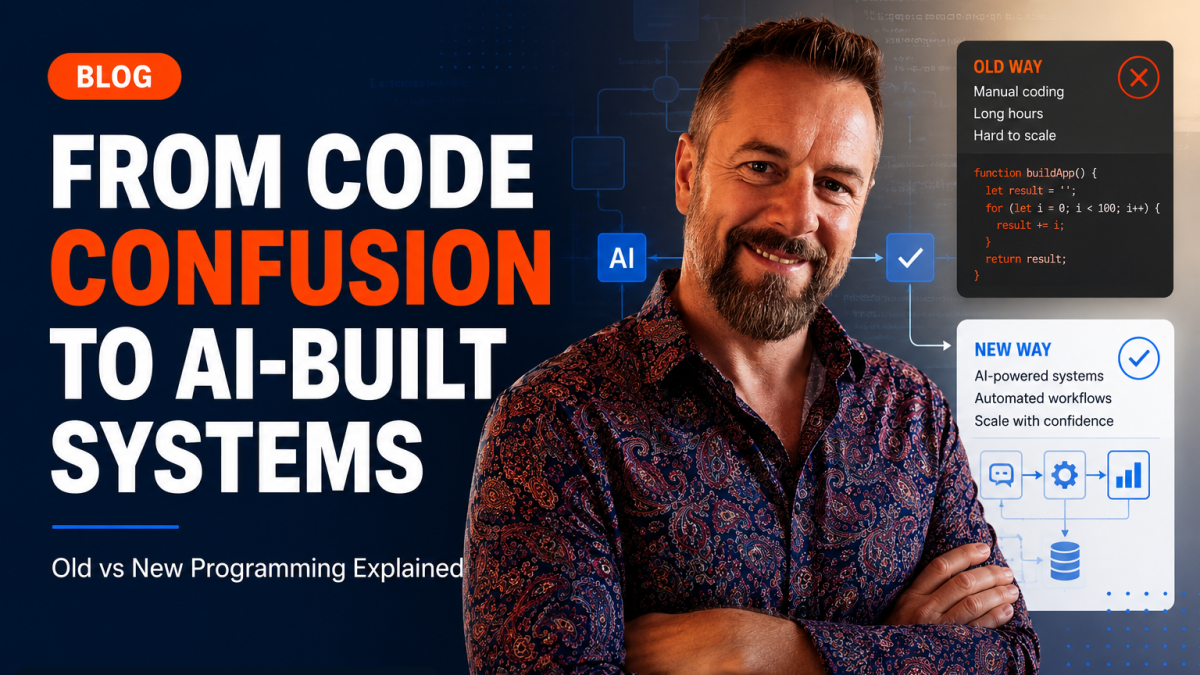
AI coding is changing how software gets built, moving from line-by-line programming to AI-built systems. Old vs New Programming Explained.
AI coding is changing how software gets built.
For years, programming felt like a technical gatekeeping system. You either learned the syntax, frameworks, and debugging process, or you stayed dependent on developers, agencies, or expensive software tools.
That model is changing.
We are moving from manual line-by-line programming to outcome-driven system building where AI helps generate, structure, and accelerate development.
This shift matters because it changes who can build, how quickly ideas become real products, what skills matter most, how creators and businesses use technology, and how modern online businesses get built.
The future is not about replacing developers. It is about reducing friction between ideas and execution.
What Is AI Coding?
AI coding is the use of artificial intelligence to help generate, improve, explain, debug, and structure software development.
Instead of manually writing every line of code from scratch, users can now describe what they want to build and let AI generate a working starting point.
- writing functions
- generating website layouts
- building automations
- creating APIs
- debugging code
- generating frontend interfaces
- building backend logic
- connecting systems together
The starting point changes. Instead of beginning with syntax, you begin with intent.
The Old Way: How Traditional Programming Worked
Traditional programming was built around learning specific languages and ecosystems.
- syntax
- variables
- functions
- loops
- data structures
- frameworks
- debugging
- deployment
- maintenance
| Language | Common Use |
|---|---|
| Python | Automation, AI, backend systems |
| JavaScript | Frontend interaction and web apps |
| C++ | Performance-heavy applications |
| PHP | Websites and backend systems |
| Ruby | Web applications |
| Java | Enterprise systems and Android apps |
The old process looked something like this:
- Choose a language
- Learn the syntax
- Understand the framework
- Write the logic manually
- Test and debug the result
- Deploy the application
- Maintain it long term
That system built the modern internet. But it also created a major barrier for creators, educators, and business owners who had ideas but not deep technical knowledge.
The Web Changed Programming by Creating Layers
Modern web development introduced a more layered structure.
Frontend technologies
The frontend is what users see.
- HTML for structure
- CSS for visual styling
- JavaScript for interaction
Backend technologies
The backend is what makes the system work behind the scenes.
- databases
- payment systems
- automations
- user accounts
- APIs
- business logic
A simple contact form might involve frontend HTML, JavaScript validation, backend Python processing, database storage, email automation, and API connections.
The internet became system-based. That matters because AI coding is now accelerating the creation of those systems.
Where AI Coding Changes Everything
AI coding changes the relationship between the builder and the technology.
Instead of asking:
How do I write this in Python?
You can now ask:
Build a tool that recommends products based on user answers.
AI can generate code, explain code, refactor code, identify errors, suggest improvements, connect APIs, create frontend layouts, generate backend logic, and help deploy applications.
For creators and founders, that means ideas can move faster.
Why Python Became So Important in AI Coding
Python has become one of the most important languages in AI workflows because it is readable, flexible, beginner-friendly, supported by huge libraries, and heavily adopted in AI and data science.
Many AI systems use Python as the human-friendly orchestration layer. Underneath, lower-level systems may still rely on C++, CUDA, Rust, or specialised hardware acceleration.
AI coding reduces dependency on memorising syntax. The emphasis moves toward system thinking.
From Writing Code to Directing Outcomes
This is the real transformation.
The future is not just “vibe coding”. A better description is outcome-driven engineering.
The old question was:
How do I code this?
The new question is:
What outcome do I want?
When the focus moves from syntax to outcomes, builders think differently, workflows change, software development speeds up, creators gain leverage, and system design becomes more valuable.
Old Programming vs AI Coding
| Traditional Programming | AI Coding |
|---|---|
| Syntax-first | Outcome-first |
| Manual coding | AI-assisted generation |
| High technical barrier | Lower starting barrier |
| Slower prototyping | Faster experimentation |
| Developer-led | Builder-led |
| Heavy memorisation | System thinking |
| Manual debugging | AI-assisted debugging |
| Language-focused | Workflow-focused |
Real Examples of AI Coding for Creators
- course recommendation tools
- lead qualification systems
- onboarding workflows
- AI-powered assistants
- dashboards
- content repurposing systems
- email workflow automations
- booking systems
- searchable knowledge bases
- simple SaaS tools
These ideas previously required developers, larger budgets, longer timelines, and technical teams. Now many can be prototyped quickly using AI coding workflows.
What AI Coding Still Cannot Do Well
AI coding is powerful, but it is not magic.
AI can generate code that looks correct, behaves incorrectly, creates security risks, breaks at scale, uses poor architecture, or becomes difficult to maintain.
This is why human judgement still matters.
- AI generates. You evaluate.
- AI accelerates. You direct.
- AI suggests. You decide.
The winners will be the people who think clearly, define requirements properly, understand systems, test outcomes, improve workflows, and recognise quality.
Do You Still Need to Learn Coding?
Yes, but not in the same way.
You do not need to memorise every syntax rule or become fluent in every framework. But you should understand how systems connect, frontend vs backend, APIs, workflows, data movement, validation, testing, and user interaction.
The most valuable modern skill is not memorisation. It is structured thinking.
The Most Valuable Skills in the AI Coding Era
1. Logical thinking
Can you break a problem into clear steps?
2. System design
Can you understand how moving parts connect together?
3. Communication clarity
Can you explain outcomes clearly enough for AI to interpret correctly?
4. Testing and validation
Can you recognise when something is wrong even if it looks correct?
5. Workflow thinking
Can you build repeatable systems instead of isolated tasks?
Why AI Coding Matters for Online Businesses
AI coding is not only about software developers. It is a leverage tool for modern business building.
Creators and founders can use it to test ideas faster, automate repetitive work, create internal tools, improve workflows, build custom experiences, reduce operational friction, and prototype products rapidly.
One person with strong systems thinking and AI support can now execute at a level that previously required an entire team.
The Opportunity and the Risk
The opportunity is obvious. More people can build. Ideas move faster. Small teams gain leverage. Creators can launch tools without waiting months.
But there is also a risk.
If everyone has access to the same AI systems, average output becomes easier to create. That means the internet will fill with generic tools, copied systems, low-quality products, repetitive workflows, and shallow automation.
The advantage is no longer simply coding ability. The advantage becomes judgement, strategy, clarity, systems thinking, creativity, communication, and execution quality.
FAQs About AI Coding
Is AI coding replacing developers?
No. Developers are still essential for complex systems, architecture, scalability, security, and advanced engineering. AI coding changes workflows. It does not eliminate expertise.
Can beginners use AI coding tools?
Yes. AI coding lowers the starting barrier significantly. Beginners can prototype ideas much faster than before.
Is Python the best language for AI coding?
Python is one of the most widely used languages in AI because of its readability and ecosystem support. But AI systems still rely on many other languages underneath.
What is outcome-driven engineering?
Outcome-driven engineering focuses on defining the result first instead of manually coding every implementation detail. The user describes the goal. AI helps generate the structure.
Is AI-generated code safe?
Not automatically. AI-generated code still needs testing, review, validation, debugging, and security checks.
What should creators learn first?
Creators should focus on workflows, system thinking, APIs, frontend vs backend concepts, logical problem solving, and AI-assisted building.
Related Articles You Should Read
If you want to go deeper into AI coding, systems thinking, and structured business workflows, these React Creator articles connect naturally with this topic.
- AI Productivity Systems for Business Owners
- How to Use ChatGPT for Business Owners
- AI Prompt Framework for Better ChatGPT Results
- How to Build a Custom GPT for Your Business
- How to Use AI Agents in ChatGPT
- ChatGPT Memory Settings Explained for Business
- Free AI SEO Audit and Website Action Plan
- Systems-First Leadership
The Future of AI Coding
Code is not disappearing. But coding is becoming more invisible.
The user describes the outcome. AI suggests the structure. The human directs, validates, improves, and strategically guides the result.
This is another major abstraction layer in technology.
We already moved from machine code to programming languages, from hand-coded websites to visual builders, and from manual servers to cloud infrastructure.
AI coding is another layer higher. That changes who can participate.
What You Should Do Next
Think in outcomes, not tools
Start with the result before choosing the technology.
Learn how systems connect
Understand frontend, backend, APIs, workflows, automations, and user actions.
Use AI coding regularly
Build small tools. Experiment. Prototype ideas. Learn by doing.
Do not skip testing
AI output still requires judgement.
Improve your communication
The clearer your instruction, the stronger the AI result.
Conclusion: This Changes Who Wins
AI coding does not remove skill. It changes where skill matters.
The winners will not simply be the people who can write code fastest.
The winners will be the people who define better outcomes, think in systems, communicate clearly, test properly, direct AI effectively, and turn ideas into useful workflows.
The barrier is no longer only technical knowledge. The barrier is clarity.
That is the shift.
From code confusion to AI-built systems. From syntax to strategy. From manual programming to outcome-driven building.
This is not the end of coding. It is the upgrade.
Join the Mentorship and Start Your Journey
If you want to learn how to build with systems instead of guesswork, the React Creator Mentorship is designed to help you think, build, and execute like a real business owner.
Inside the mentorship, you will learn how to use AI with structure, build repeatable workflows, create clearer offers, think in systems, reduce friction in your business, and turn ideas into real assets.
This is not passive theory. It is a founder-led implementation program focused on practical execution, systems thinking, and modern business building.
Join the Mentorship and Start Your Journey
Categories: : AI for Business, Systems-Building
Register for the Blog
By signing up for our blog, you can stay informed about the newest advancements in system construction and AI. We consistently create fresh and captivating posts, often including videos for your enjoyment.
Build a Real Online Business - with systems, not guesswork.
3 Month Mentorship to get started or diagnose blockages in workflows - Join Me on your Journey!
A proof-focused cohort mentorship led by a 30+ year design & marketing veteran to help you build clarity, structure, and a launch-ready business.
Specially designed for Coaches, Course Creators, Wellness and wellbeing, Digital product creators who are starting or their businesses are stuck!