The Death of the Click: How AI Is Rewriting the Rules of Paid Search
 David Newton
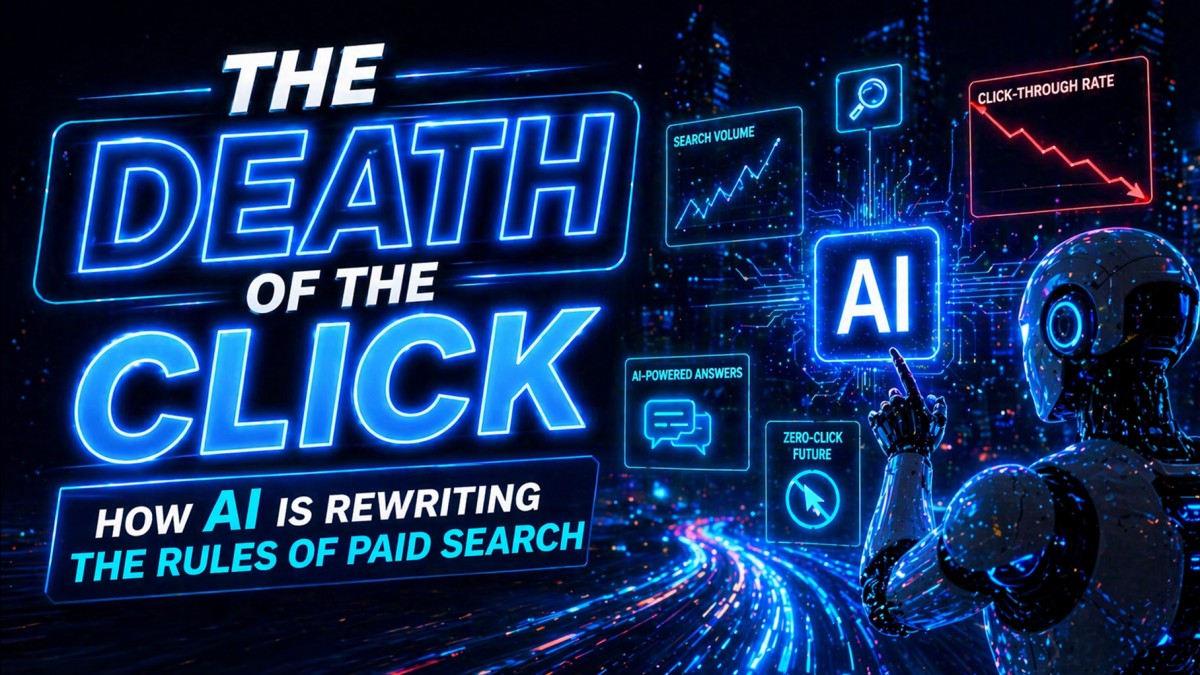
CPCs are at a six-year high. Paid CTRs have collapsed by 68%. And now ChatGPT has ads.
Paid search is not dead, but the click is no longer the centre of the system. AI now answers more questions before people visit a website, which means fewer clicks, higher costs, and stronger pressure on weak campaigns. The businesses that win in this new environment will not be the ones chasing more traffic. They will be the ones building better systems: content for discovery, clear sales pages for conversion, first-party data for follow-up, and a structure that matches how people actually move from question to decision.
The search landscape has changed more in the last 18 months than in the previous decade. Here is what the data actually says.
For most of the internet's commercial life, paid search was one of the most reliable investments in marketing. You found a keyword, you bid on it, someone searched for it, they clicked your ad, and if everything downstream worked, they bought something. The logic was clean. The feedback loop was tight. The ROI was measurable to the decimal point.
That model is not broken. But it has changed quickly, and many advertisers still have not fully adjusted.
The shift is not mainly about bidding strategies or campaign structures. It is about something more fundamental: where people go when they have a question, and what they find when they get there.
The Numbers That Should Alarm Every Advertiser
Let’s start with the data, because the scale of what has happened to paid search deserves to be stated plainly.
68%
Drop in paid click-through rate on queries featuring Google AI Overviews, from 19.7% to 6.34%, between June 2024 and September 2025, according to a Seer Interactive analysis of 3,119 search terms across 42 organisations.
That is not a gradual erosion. That is a structural collapse of a core performance metric. It also did not arrive evenly. In a single month, July 2025, paid CTR fell from approximately 11% to 3% as Google expanded AI Overviews aggressively into commercial and navigational queries.
- 87% of industries saw year-over-year CPC increases in 2025
- $5.26 cross-industry average Google Ads CPC, with legal services averaging $8.58
- 50% increase in overall search impressions year over year, while paid CTRs fell by roughly 33%
The paradox buried in those numbers is worth pausing on: more impressions, fewer clicks, higher costs.
Visibility has increased. But the intent to click through to a website, to leave the search results page at all, has been steadily drained.
Paid search CPCs, meanwhile, have reached their highest level in six years according to Skai's Q3 2025 Digital Advertising Trends Report. The cross-industry average now sits at $5.26 per click, and in competitive verticals like legal services, B2B software, and finance, advertisers are routinely paying $8 to $9 per click, and higher.
What’s Actually Causing This
The surface explanation is straightforward. Google’s AI Overviews now sit at the top of search results, answer the user’s question, and push paid ads further down the page. Fewer people scroll. Fewer people click. Advertisers compete harder for the remaining inventory. Prices go up.
But several forces are compounding at once.
1. The SERP real estate problem
AI Overviews are not a small feature. Research from Semrush and Datos found AI Overviews appearing on 13.14% of US desktop searches as of March 2025, up from 6.49% in January of the same year. SE Ranking estimated the figure at 30% of tracked US keywords by May 2025. Conductor found them on 16% of 118 million keywords.
Every methodology measures a different slice of the market, but the direction is clear. AI Overviews are growing. Depending on the dataset, they are appearing in somewhere between one in seven and one in three searches. And when an Overview appears, ads that fall below it see a sharp reduction in impression share and CTR.
2. Smart bidding is eating itself
There is a bitter irony in how Google’s own automation is contributing to the cost spiral. Smart Bidding strategies such as Maximize Conversions, Target ROAS, and Target CPA optimise toward conversion predictions rather than cost efficiency. When most advertisers in an auction are using similar automated strategies, the algorithms collectively push CPCs toward the maximum each advertiser can theoretically afford.
The competition is no longer just between businesses. It is between machine-learning systems trained to extract maximum value from every impression.
3. Impression share is concentrating upward
Google’s double-serving policies, which limit how often the same advertiser appears on a single results page, have effectively concentrated impression share among larger advertisers. Smaller and medium-sized businesses are being squeezed into bidding more aggressively for a smaller share of inventory.
The result is a market that increasingly rewards scale, not just quality.
4. The buyer journey is fragmenting
This is the least visible but arguably most important shift. Users are no longer doing all their information gathering on Google and their buying elsewhere. They are doing some of that information gathering inside AI tools such as ChatGPT, Perplexity, and Google’s own AI experiences, and sometimes arriving at a purchase decision without ever clicking a traditional ad.
According to data cited by Bain, 80% of consumers resolve 40% of their searches directly on the results page.
For 25 years, marketers optimised for rankings, clicks, and traffic. That is no longer the whole picture.
The Nuance That Changes Everything
This is where the analysis becomes more interesting.
If paid search were simply dying, the strategic answer would be simple. Shift budget elsewhere and wait for the dust to settle. But that is not what the data shows.
A benchmark analysis of 16,446 campaigns found that while overall click volume declined across nearly all query types in 2025, 65% of industries actually saw improved conversion rates. In some sectors, the improvement was dramatic. Education and instruction saw conversion rates jump 43.87% year over year. Sports and recreation climbed 42.43%.
The explanation is counterintuitive but important.
AI Overviews are pre-qualifying users.
By answering basic informational questions before a user ever reaches a paid ad, they filter out a large share of the low-intent traffic. The people who do click past an AI Overview are often further down the funnel. They already understand the basics. They are looking for something specific.
What this means in practice
The math is changing in a way that CTR alone does not capture.
A campaign generating 1,000 clicks at $2.00 CPC with a 2% conversion rate produces 20 conversions. In an AI Overview environment, that same campaign might generate 400 clicks at $3.50 CPC, but convert at 5%. The cost per acquisition can improve even as CPCs rise and clicks fall.
That will not apply universally. But it does show where the opportunity now sits.
The key variable is query type. AI Overviews are most disruptive to informational queries such as how-to content, definitions, comparisons, and research-phase searches. They are less disruptive to transactional queries, where someone is ready to act.
The implication is straightforward. Advertisers who relied on informational paid traffic to fill the top of the funnel are under the most pressure. Advertisers with tighter transactional strategies and stronger audience data are better positioned.
Enter ChatGPT Ads: A New Battlefield Opens
While Google Ads has been absorbing these changes, a new advertising channel has emerged.
ChatGPT advertising introduces a different kind of commercial environment. Google Ads sits in the gap between a user’s search query and their destination. ChatGPT ads live inside the conversation itself.
That matters because the user signal is different.
On Google, someone might type:
best CRM for small business
Inside a conversational AI system, they are more likely to describe a situation:
I run a five-person consulting firm, we are using spreadsheets to manage clients, and I think we are wasting hours every week on manual admin.
That is not a keyword. It is a brief.
And a user expressing intent that way creates a different kind of opportunity for the advertiser who can respond at the right moment.
The platform is still early. Costs are high. Reporting is limited. Inventory is constrained. But structurally, it points to where search behaviour is going next.
The SEO and Paid Search Convergence
One of the most important strategic shifts happening in parallel is the collapse of the old wall between SEO and paid search.
For most of digital advertising history, they operated on separate logic. SEO was about long-term authority and organic visibility. Paid search was about immediate, measurable intent capture. Different teams. Different tools. Different reporting.
AI Overviews have started to collapse that boundary.
The content that gets cited inside AI Overviews usually comes from domains already ranking strongly. That means content authority now has a direct effect on how visible and credible a brand becomes during the research stage.
And once a brand is surfaced in AI-generated summaries, paid performance can benefit too. A brand that is already recognised gets clicked more confidently.
The practical takeaway is simple:
The best paid search strategy in 2026 often starts with a content strategy.
Brands that build genuine topical authority, earn mentions, structure their content clearly, and become easy for AI systems to cite are creating an advantage that shows up downstream in paid performance too.
How To Adapt: A Strategic Framework
So what does a sensible paid search strategy look like now?
The data points toward a few clear priorities.
Protect your branded baseline first
Branded keywords represent demand you have already created through every other marketing activity. They are the highest-converting, most defensible inventory in most accounts.
In a market where AI Overviews disrupt non-branded traffic, branded search becomes even more valuable.
Shift budget toward transactional intent
Informational queries are the most vulnerable to AI Overview disruption. They are also the least ready to convert.
Reallocating budget from informational to transactional terms usually means fewer clicks at higher CPCs, but better conversion efficiency.
Build first-party audience data aggressively
As cold search traffic becomes harder to capture efficiently, first-party data becomes more valuable. Users who already know your brand search differently and convert more easily.
Optimise the whole click, not just the ad
When each click costs more, your landing page matters more. Page speed, mobile usability, trust signals, and one clear next step are no longer nice to have. They are central to ROI.
Invest in AI citation
Being cited in AI Overviews and AI-generated answers is becoming the new version of early-stage visibility. The content investment required is similar to strong SEO, but the payoff now extends into paid performance too.
Monitor conversational ad environments early
Even if you are not buying yet, understanding how conversational ad systems work is already valuable. The businesses that learn early will move faster when the channel matures.
The Underlying Reality
Paid search has not stopped working.
The channel is not dying. But it is becoming more expensive, more concentrated, and more dependent on quality. Not just quality of ad copy or keyword selection, but quality of intent, audience data, content authority, and landing page experience.
The deeper shift is in what search itself has become.
For the first twenty-five years of commercial search, the dominant behaviour was simple: type some words, get some links, click one.
That behaviour is changing.
Users increasingly expect answers, not lists of links. They want synthesis, not just options. AI tools are built to deliver exactly that.
The advertisers who adapt to that shift are not just protecting performance. They are building a stronger competitive position for what comes next.
The click is not dead.
But what earns it, and what it costs, has changed permanently.
How to Build a Paid Search System That Still Works in an AI-First World
If the click is becoming more expensive and less predictable, the answer is not to optimise harder inside the same model.
The answer is to change the system you are operating inside.
Most advertisers are still thinking in campaigns. What this shift requires is systems thinking.
A system that does three things well:
- captures demand when it exists
- creates demand when it does not
- compounds performance over time
Here is what that looks like in practice.
Step 1: Redefine what a click is worth
Before you change anything tactical, you need to fix the underlying logic.
In the old model, a click was:
- cheap
- frequent
- easy to replace
That is no longer true.
Today, a click is:
- more expensive
- more qualified
- more valuable
So the system needs to reflect that.
Instead of asking, How do we get more clicks?
Ask, How do we extract more value from each click we are already paying for?
That one shift changes everything downstream.
It moves your focus toward:
- conversion rate
- landing page clarity
- offer strength
- audience quality
Without that foundation, everything else becomes expensive guesswork.
Step 2: Split your strategy by intent, not just keywords
Most accounts are still organised around keyword groupings.
That is no longer enough.
You need to think in intent layers:
Transactional intent
People ready to act.
Examples:
- buy CRM software
- hire CRM consultant
Commercial investigation
People comparing options.
Examples:
- HubSpot vs Pipedrive
- best CRM for small agencies
Informational intent
People learning.
Examples:
- what is a CRM
- how to manage client data
This is where AI Overviews are doing the most damage.
The practical decision is simple:
- protect and scale transactional
- compete selectively in commercial
- stop relying on informational paid traffic
Instead of forcing ROI from top-of-funnel clicks, build a system that supports top-of-funnel intent elsewhere.
Step 3: Move top-of-funnel discovery out of paid search
This is where many advertisers get stuck.
They keep trying to make informational queries work with paid traffic, even as AI absorbs that intent.
The better move is simple:
Let AI handle more of the early discovery. Your job is to become the source it pulls from.
That means building:
- structured blog content
- clear comparison pages
- data-backed insights
- strong internal linking
This is not SEO for traffic alone.
This is SEO for visibility, trust, and AI citation.
When your content gets surfaced, cited, and associated with your brand, you gain:
- higher trust
- better branded search behaviour
- stronger downstream paid performance
That is where SEO and paid search stop acting like separate channels.
They become one system.
Step 4: Build a first-party data loop
Cold traffic is becoming less reliable.
Warm traffic is becoming more valuable.
So the system needs a way to capture and reuse attention.
That means:
- email capture tied to real value
- lead magnets that solve actual problems
- remarketing audiences built intentionally
- CRM tracking that feeds back into campaigns
Not as a side tactic.
As a core system layer.
Because once someone knows you:
- they search differently
- they click more confidently
- they convert at a higher rate
That is how you reduce dependence on expensive cold clicks.
Step 5: Treat landing pages as profit levers
Most advertisers still treat landing pages like static assets.
That no longer works.
When clicks cost more, the landing page becomes one of the highest-leverage points in the entire system.
A strong setup focuses on:
- one clear outcome per page
- fast load speed
- immediate clarity above the fold
- visible trust signals
- minimal distraction
Even small improvements matter.
A move from 2% to 3% conversion rate can outperform hours of campaign tweaking.
This is where systems thinking beats platform thinking.
Step 6: Add a conversational layer early
This is where the market is heading next.
Not in five years. Now.
Platforms like ChatGPT are introducing a new type of intent. It is longer, more specific, and more contextual.
Instead of keywords, users describe situations.
So your system needs to prepare for that by:
- creating content that answers real scenarios
- structuring offers clearly enough to be referenced
- observing how AI platforms present solutions
- learning how conversational ad environments behave
You do not need to go all in yet.
But you do need to understand the layer that is forming.
Step 7: Connect everything into one system
This is the part most businesses still fail to do.
They optimise channels separately instead of connecting them.
A working system looks like this:
- content builds authority and earns AI visibility
- AI visibility increases brand recognition
- brand recognition improves paid search performance
- paid traffic feeds first-party data
- first-party data improves targeting and conversion
- landing pages convert more efficiently
- insights feed back into content and campaigns
That loop compounds.
Over time, it becomes harder to replicate.
Not because your ads are better.
Because your system is better.
The real shift
The mistake is thinking this is just a paid search problem.
It is not.
It is a systems problem.
The advertisers struggling most are still trying to optimise inside a model that no longer behaves the same way.
The ones adapting are doing something different.
They are building systems that:
- reduce reliance on any single channel
- improve performance across channels
- get stronger over time instead of weaker
That is the opportunity inside this shift.
Not cheaper clicks.
Better systems.
Beginner Friendly AI Search Intent: Two Real Campaign Examples
Most beginners struggle with the same thing.
They understand keywords.
They do not fully understand intent.
And in an AI-first search environment, that difference matters more than ever.
So instead of explaining the theory again, let’s use two simple examples:
- a dog trainer
- a communication or life coach
Different industries. Same logic.
Example 1: Dog training business
The old way
A beginner dog trainer might run ads like:
- dog training near me
- how to train a puppy
- stop dog barking
And send everything to one page.
It feels logical.
But it mixes completely different types of intent.
The real intent behind those searches
Situation 1: Urgent problem
“My dog will not stop barking at night.”
This person is:
- frustrated
- tired
- ready to fix it
That is high intent.
Situation 2: Confused owner
“I just got a puppy. I do not know where to start.”
This person is:
- early stage
- researching
- not ready to buy yet
That is low intent.
Situation 3: Considering help
“Should I hire a dog trainer?”
This person is:
- aware of the problem
- evaluating options
That is mid intent.
What the campaign structure should look like
Campaign 1: High intent
Keywords:
- dog trainer near me
- dog training service
- fix dog barking fast
Ad message:
- Stop Your Dog Barking - Professional Help Available
- 1-to-1 Dog Training That Actually Works
Destination:
A sales page with a clear service, clear outcome, and simple booking path.
Campaign 2: Mid intent
Keywords:
- is dog training worth it
- dog trainer cost
- best dog trainer
Destination:
A decision page that explains when training is needed, what to expect, and when professional help makes sense.
Campaign 3: Informational
Keywords:
- how to train a puppy
- how to stop barking
Do not rely on ads here.
Create a blog post instead that answers the question clearly, includes examples, and introduces your brand early.
What happens next
Someone reads your guide on how to stop a dog barking at night.
Later, they search for a dog trainer.
Now they recognise your name, trust you more, and are more likely to click.
That is the system working.
Example 2: Communication or life coach
Same structure. Different offer.
The old way
A coach might run ads like:
- life coach
- how to be more confident
- improve communication skills
And again, send everything to one page.
Same mistake.
The real intent behind those searches
Situation 1: Immediate pain
“I keep messing up conversations at work.”
This person is:
- aware of the issue
- feeling pressure
- open to help
High intent.
Situation 2: Self-improvement stage
“How can I be more confident?”
This person is:
- exploring
- not committed yet
Low intent.
Situation 3: Considering support
“Do I need a life coach?”
This person is:
- aware
- comparing options
Mid intent.
What the campaign structure should look like
Campaign 1: High intent
Keywords:
- communication coach
- life coach for confidence
- coaching sessions
Destination:
A sales page with a clear outcome, a simple explanation of the offer, and a booking or consultation step.
Campaign 2: Mid intent
Keywords:
- is life coaching worth it
- communication coach benefits
- how coaching works
Destination:
A decision page that removes uncertainty, shows how coaching helps, and leads naturally to the sales page.
Campaign 3: Informational
Keywords:
- how to be more confident
- how to communicate better
Destination:
A blog post that answers the question, builds trust, and creates early discovery.
What both examples show
Different industries. Same pattern.
1. Intent is about situations, not keywords
People do not think in keywords. They think in problems.
2. Paid ads work best closer to the decision stage
When someone is ready, they click and convert.
3. Content handles early discovery
Your content answers questions, builds recognition, and supports later search behaviour.
4. Systems beat tactics
The difference is not better ads in isolation. It is a connected system aligned to real behaviour.
The simple way to apply this
If you are just starting:
- pick one service you offer
- identify three real situations your customer is in
- build one sales page for the highest-intent situation
- use a decision page only if people need more clarity before buying
- create blog content for the earlier-stage questions
That is enough to build a working system.
What To Actually Build - And How It All Connects
At this point, most people understand the big idea:
- intent matters
- AI is changing discovery
- systems beat isolated campaigns
But this is where things usually fall apart.
Because the next question is the practical one:
What do I actually need to create?
So let’s make this simple.
You only need four core pieces:
- sales page
- decision page
- informational blog content
- capture layer
That is your minimum viable marketing system.
1. Sales page
This is the page where someone decides to work with you.
It is the page that sells the offer.
For most service businesses, this is a self-contained page on your website such as:
-
/dog-training -
/communication-coaching
It should include:
- the problem you solve
- who the offer is for
- the outcome someone can expect
- how your service works
- a clear next step such as booking, applying, or enquiring
This is the page you use for:
- paid ads
- direct visits
- branded search
- email traffic
If someone is ready to act, this is where they should land.
2. Decision page
This page sits before the sales page.
Its job is not to close the sale. Its job is to help someone decide whether they actually need help.
Typical examples might be:
-
/do-you-need-a-dog-trainer -
/do-you-need-a-communication-coach
It should include:
- signs someone has the problem
- what usually happens when they try to fix it alone
- when getting help makes sense
- what kind of result support can create
- a calm next step to the sales page
This page is useful when someone is aware of the problem, but still unsure whether they need a professional.
Not every business needs one immediately. But when hesitation is high, it becomes useful.
3. Informational blog content
This is your discovery layer.
These are the blog posts that answer the early questions people ask before they are ready to buy.
Examples:
-
/blog/how-to-stop-a-dog-barking-at-night -
/blog/how-to-communicate-clearly-at-work
These posts should include:
- a real explanation of the problem
- useful steps or examples
- practical advice
- clear links to the next relevant page
This content helps you:
- get found in search
- get picked up by AI tools
- build trust early
- create brand familiarity before someone is ready to act
This is not usually where the sale happens.
It is where the relationship often starts.
4. Capture layer
This is the simple mechanism that helps you stay connected if someone is not ready yet.
It can be:
- a checklist
- a guide
- a downloadable PDF
- a simple form
- an enquiry form embedded on the page
Examples:
- Dog Behaviour Checklist
- Simple Communication Framework PDF
This usually lives:
- inside the blog post
- inside the sales page
- or on a small standalone opt-in page
Its job is simple:
- capture email or enquiry
- let you follow up
- keep your business visible
This gives you another chance to convert later.
How the flow actually works
This is the part most people need spelled out clearly.
Flow 1: From AI or Google search
- Someone searches a question
- They find your blog post
- They understand the problem more clearly
- If needed, they move to your decision page
- They move to your sales page when they are ready
- They book, enquire, or apply
Flow 2: From higher-intent search or ads
- Someone searches with stronger intent
- They click your ad or listing
- They land on your sales page
- They take action
Flow 3: From capture
- Someone reads your content but is not ready yet
- They download your guide or submit their email
- You follow up
- You send them back to your sales page later
Different entry points.
One connected path.
Dog training example
Sales page
What to create:
Dog Training Service - Stop Barking and Behaviour Issues
What it does:
Sells the service clearly and gives someone a direct way to book.
Decision page
What to create:
Do You Need a Dog Trainer?
What it does:
Helps someone decide whether professional training is the right next step.
Blog post
What to create:
How to Stop a Dog Barking at Night
What it does:
Answers an early-stage problem, builds trust, and creates discovery through search and AI.
Capture layer
What to create:
Dog Behaviour Checklist
What it does:
Captures email so you can follow up with someone who is not ready yet.
Communication or coaching example
Sales page
What to create:
Communication Coaching for Professionals
What it does:
Explains the offer, the outcome, and the next step.
Decision page
What to create:
Do You Need a Communication Coach?
What it does:
Helps someone understand when coaching makes sense and why they might need support.
Blog post
What to create:
How to Communicate Clearly at Work
What it does:
Answers a common early-stage problem and builds trust before someone is ready to buy.
Capture layer
What to create:
Simple Communication Framework PDF
What it does:
Captures contact details and gives you a way to continue the relationship.
The part most people miss
The system does not work just because the pieces exist.
It works because the pieces are connected.
That means:
- blog posts should link to the decision page or sales page
- decision pages should lead to the sales page
- sales pages should include one clear next step
- emails should send people back to the sales page
- ads should only go to pages that match the intent of the search
Every piece should move someone forward.
If a page has no next step, it is probably leaking attention.
A simple starting point
If you want the simplest possible version of this, build:
- one blog post
- one sales page
- one simple capture layer
Then add a decision page if your audience needs more clarity before buying.
That is enough to start building a real system.
Where AI fits into all this
AI is not a separate strategy sitting off to one side.
It sits on top of the system you build.
It influences:
- what people see first
- which content gets surfaced
- how trust is built before the click
- when someone decides to move forward
Your job is not to fight that.
Your job is to create content and pages that make your business easy to find, easy to understand, and easy to trust.
The real execution insight
The goal is not:
- more traffic
- more clicks
- more campaigns
The goal is to build a simple system that turns attention into action.
That system should:
- handle discovery through content
- help people self-identify through clarity
- convert demand through a sales page
- keep the relationship open through capture
- improve over time as you learn what works
Once that is in place, everything else becomes easier.
Conclusion
It is easy to look at all of this and assume the story is mainly about AI, new platforms, or paid search tactics.
But the deeper shift is simpler than that.
The way people move from question to decision has changed.
For a long time, the path looked like this:
- search
- click
- browse
- decide
Now it increasingly looks like this:
- ask
- understand
- refine
- act
AI has compressed the early part of the journey. People often arrive later, with more context, more clarity, and stronger intent.
That changes what content should do, what ads should do, and what your website needs to support.
If you are still relying on broad traffic, generic pages, and disconnected campaigns, the market will feel harder than it used to. More expensive. Less predictable.
But if you build around how behaviour actually works now, things become clearer.
You do not need more moving parts.
You need better alignment.
Your blog content handles discovery.
Your decision page builds clarity when needed.
Your sales page converts.
Your capture layer keeps the relationship open.
That is the system.
And that is the real shift behind all of this.
The click still matters.
It is just more valuable now.
Which means the businesses that win will not be the ones doing more.
They will be the ones building better.
Clearer systems. Better alignment. Less guesswork.
That is the advantage now.
To Summarise
Paid search is not dead, but the way it works has changed.
AI tools are answering more questions before a click happens, which means fewer people leave the search results page and the clicks that remain are often more expensive. That has made old paid search models less reliable, especially for informational queries. But it has also made the remaining clicks more qualified, which is why strong advertisers are still seeing good conversion performance.
The real shift is not just about ads. It is about behaviour. People now move from question to decision differently. They ask, understand, refine, and then act. That means businesses need a connected system, not isolated campaigns.
A simple version of that system is this: blog content handles discovery, a decision page builds clarity when someone is unsure, a sales page converts when they are ready, and a capture layer keeps the relationship open if they are not ready yet. AI sits on top of this system by influencing what people see first and which brands they recognise later.
The businesses that adapt will not be the ones chasing more clicks. They will be the ones building better systems - with stronger content, clearer sales pages, better audience data, and a structure that matches how people actually buy now.
Conclusion
Paid search is not disappearing. But it is no longer operating on the same rules.
The last 18 months have changed where attention starts, how intent is expressed, and when people decide to act. AI has compressed the early stages of the journey, filtered out low-intent traffic, and made every remaining click more valuable.
That creates pressure if you are relying on volume.
But it creates an advantage if you are structured properly.
The difference now is not who runs more campaigns.
It is who builds the better system.
A system that:
- gets discovered through useful content
- builds clarity before the click
- converts through a focused sales page
- captures attention for follow-up
- improves over time
This is what replaces the old model of chasing traffic and optimising in isolation.
The click still matters. In many cases, it matters more than it used to.
But what earns it has changed.
The businesses that adapt will not be the ones doing more.
They will be the ones building with more clarity, less friction, and stronger alignment between what people need and what they find.
That is the shift.
And that is where the advantage now sits.
FAQs
1. Is paid search dead because of AI?
No. Paid search still works, but the environment around it has changed. AI is reducing low-intent clicks and making the remaining clicks more valuable.
2. Why are paid search clicks dropping?
More users are getting answers directly on the search results page through AI Overviews and other AI-generated experiences, so fewer people need to click through to websites.
3. Why are Google Ads getting more expensive?
CPCs are rising because competition is increasing, inventory is tighter, and advertisers are bidding harder for the clicks that still happen.
4. What is an AI Overview?
An AI Overview is Google’s AI-generated summary that appears at the top of some search results and answers a user’s question before they click a website.
5. Do AI Overviews hurt every type of search query?
No. They affect informational queries the most. Transactional queries, where someone is ready to act, tend to remain more commercially valuable.
6. Are fewer clicks always a bad thing?
Not necessarily. In some cases, fewer clicks can mean higher-quality traffic and better conversion rates.
7. Why are conversion rates improving in some paid search campaigns?
Because AI is filtering out some of the lower-intent users before they click, leaving more qualified users to reach the ad and landing page.
8. What does this mean for small businesses?
Small businesses need to be more selective. Instead of trying to target everything, they should focus on clear intent, strong content, and better conversion paths.
9. Should I stop bidding on informational keywords?
In many cases, yes for paid search. Informational content often works better as blog content designed for organic search and AI discovery rather than ad traffic.
10. What keywords should I prioritise now?
Focus first on transactional and high-intent commercial terms where the user is closer to making a decision.
11. What is a sales page in this system?
A sales page is the page where someone decides to work with you. It explains the offer, the outcome, and the next step.
12. What is a decision page?
A decision page helps someone decide whether they need professional help before they are ready to buy. It sits between a blog post and a sales page.
13. Do I always need a decision page?
No. If your offer is simple and easy to understand, a blog post can link straight to the sales page. A decision page is useful when buyers need more clarity first.
14. What role does blog content play now?
Blog content handles early discovery. It answers questions, builds trust, and gives AI systems something useful to surface and cite.
15. What is a capture layer?
A capture layer is a simple way to collect an email or enquiry so you can follow up later if someone is not ready to buy immediately.
16. How does SEO connect to paid search now?
Strong SEO content can improve AI visibility, brand recognition, and trust, which can then improve paid search performance later in the journey.
17. What is first-party data and why does it matter?
First-party data is the audience information you collect directly, such as email subscribers or customer lists. It matters because warm audiences convert better than cold traffic.
18. Should I be paying attention to ChatGPT ads already?
Yes. Even if you are not buying them yet, it is worth understanding how conversational ad environments work because they point to where search behaviour is heading.
19. What is the simplest version of the system described in this post?
One blog post for discovery, one sales page for conversion, and one simple capture layer for follow-up. Add a decision page if your audience needs more clarity before buying.
20. What is the biggest mistake advertisers are making right now?
Treating this like a campaign problem instead of a systems problem. The businesses that adapt are building connected systems, not just tweaking ads.
If You Want to Build This Properly
Everything in this article is simple in principle.
But in practice, this is where most people get stuck.
Not because they do not understand the ideas.
Because they try to piece it together without a system.
They:
- build content without a clear role
- run ads without the right pages behind them
- create pages that do not connect
- rely on tactics instead of structure
And the result is predictable.
More effort.
More spend.
Less consistency.
The shift you are seeing here is not just about AI or paid search.
It is about learning how to build a business that:
- captures attention properly
- converts it efficiently
- and improves over time
That requires a different way of thinking.
Not more tools.
Not more tactics.
A system.
This is exactly what I work through inside React Creator Mentorship.
Not theory.
Not generic advice.
But how to:
- structure your pages properly
- build content that actually supports conversion
- connect ads, SEO, and AI discovery into one system
- remove friction across your entire setup
So you are not guessing what to do next.
If you are at the point where:
- you understand the shift
- but want to implement it properly
You can explore the mentorship here.
No pressure. Just a clearer path if you need one.
Categories: : AI for Business
Build a Real Online Business - with systems, not guesswork.
3 Month Mentorship to get started or diagnose blockages in workflows - Join Me on your Journey!
A proof-focused cohort mentorship led by a 30+ year design & marketing veteran to help you build clarity, structure, and a launch-ready business.
Specially designed for Coaches, Course Creators, Wellness and wellbeing, Digital product creators who are starting or their businesses are stuck!